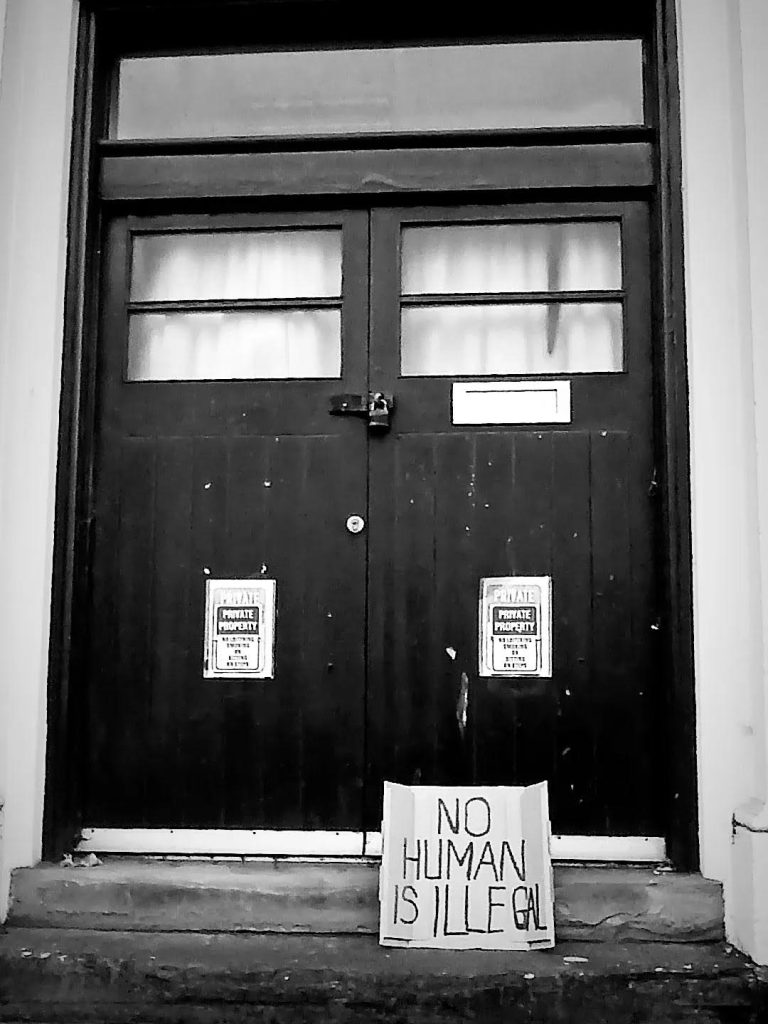
By David Stark.
For all of the constant noise about numbers, about integration and about ‘fairness’, the everyday consequences of the UK’s immigration policies on the lives of those impacted by them remain largely invisible. One place where these consequences are starkly visible, for those who care to look, is in the provision of local authority children’s services support for children who have needs arising directly from ‘hostile environment’ immigration legislation.
For families with No Recourse to Public Funds (NRPF), local authority support under section 17 of the Children Act 1989 is often the only thing standing between rudimentary security and destitution. Yet new proposals to reform this support under Schedule 12 of the Immigration Act 2016, set out in the Government consultation document Family Returns: Reforming Asylum Support and Enforcing Family Returns, seek to further weaken even this basic subsistence level provision, in an attempt to drive families out of the UK.
A safety net full of holes
Section 17 places a duty on local authorities to safeguard and promote the welfare of children “in need”. For families denied access to mainstream benefits because of their immigration status, this provision can include accommodation and small cash payments. In theory, it is a child‑centred safety net.
In practice, it is anything but secure.
Freedom of Information requests we submitted in 2025 to all 151 English local authorities reveal a striking lack of transparency. Over a quarter of authorities have reported that they hold no reliable data on whether they support NRPF‑affected families at all. More than one third do not record how many families are refused support after assessment.
This means that in large parts of England, we simply do not know how many children are being helped, how much support they receive, or how many are turned away. Policy reform is being proposed on top of a system that is already barely visible to itself.
Subsistence, not welfare
The proposed reforms are framed as a simplification of support for families without lawful status. But the danger is that “simplification” will mean formalising a minimal, survival‑only model of support.
In 2023, the High Court made clear in R (BCD by his litigation friend) v Birmingham Children’s Trust that where families are lawfully resident but denied recourse, support under section 17 must be sufficient to promote children’s welfare, and not merely to prevent starvation or street homelessness. This requires a higher standard than the bare subsistence payments used in the asylum system.
FOI evidence suggests this distinction is routinely ignored. Most local authorities provide support at or below asylum support rates, which are explicitly calculated to meet only the minimum necessary to avoid destitution. Very few authorities recognise or apply a genuine welfare standard, even where children have a clear and lawfully established right to remain in the UK.
The proposed Schedule 12 framework risks locking this practice in place, reframing children’s services as providers of emergency survival rather than welfare.
Social workers as border guards
One of several troubling aspects of the reforms- which include the introduction of the use of physical force on children- is quite how explicitly they tether child welfare to immigration control.
Under the proposed conditions, local authorities must consider whether families have made themselves “intentionally destitute”, whether they are actively seeking to leave the UK, and whether the Home Secretary considers there to be a “genuine obstacle” to their return. At the same time, authorities would be prohibited from considering factors such as whether a child would be “in need” in the parents’ country of return, or whether essential medical treatment would be available to them there.
This mirrors what is presently happening on the ground. Human Rights Assessments, which are supposed to protect families from unlawful harm, are routinely oriented towards assessing removability rather than children’s needs. Safeguarding becomes a proxy border check.
The result is a quiet but profound shift: social workers are increasingly required to make judgements about compliance, credibility and return, rather than focusing on children’s welfare and development.
The invisibility of refusal
One striking feature of the data is how rarely refusals of support appear in official records. Where refusal statistics exist at all, they are extremely low. This sits uneasily alongside extensive evidence from researchers, advice organisations and families themselves of routine gatekeeping: being turned away before assessment, discouraged from applying, or warned about potential immigration status consequences.
The most plausible explanation for this is that exclusion frequently happens before formal processes even begin, and therefore before anything is recorded. The introduction of additional eligibility conditions is likely to intensify this pattern, increasing informal exclusion while leaving it administratively invisible.
In this way, the absence of data is not just a technical failure. It functions as a governing tool, insulating everyday bordering practices from scrutiny and challenge.
Regional disparities around the numbers of families supported, and around the numbers of families recorded as having been refused suggest a correlation between families’ abilities to access advocacy, advice and legal representation, and the likelihood that they will successfully access local authority support- effectively creating a ‘postcode lottery’, in which support is routinely denied, irrespective of need, to families in given regions- meaning that a child’s experience of living with no recourse in, say, Manchester is potentially significantly different to a child’s experience of living with no recourse in Middlesbrough.
Indeed, the proposed changes to support arrangements for refused asylum seekers very specifically promote the concept that such support is to be provided at the Home Office’s discretion, rather than as a matter of right, with the legal precedent that families can be left in literal destitution.
Children’s security at risk
What gets lost in all of this is the impact on children’s lives. Limiting support to subsistence levels or denying support altogether in the absence of access to legal representation, entrenches poverty, housing precarity, and food insecurity. Restricting consideration of healthcare needs exposes families to serious risks. Treating support as conditional on parents’ behaviour, and their compliance with removal imperatives, undermines the basic principle that children should not be punished for circumstances beyond their control.
Importantly, many children affected by NRPF are British citizens. Their rights are effectively downgraded through association with a parent’s immigration status, producing a form of conditional childhood that sits uneasily with any meaningful commitment to equality or child protection.
A choice about what safeguarding means
The proposed reforms are presented as pragmatic and proportionate. But the evidence suggests they would consolidate a system in which child welfare is subordinated to immigration enforcement, support is reduced to bare survival, and exclusion is normalised through administrative opacity.
We consider that any proposals to reform local authority support under Schedule 12 should start from the premise that safeguarding children requires transparency, enforceable standards, and a clear commitment to the promotion of child welfare, rather than an emphasis on deterrence. Without mandatory data requirements, explicit recognition of welfare standards already affirmed by the courts, and protection for social workers’ professional judgement, the reforms risk deepening a system that already leaves far too many children unseen, unsupported, and unprotected.







 NRPF, child poverty and health outcomes.